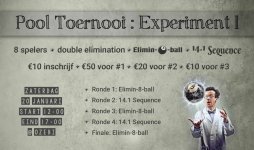
Hey everyone. For a while I’ve been thinking about innovating pool. I'm a hobby pool player and hobby boardgame designer, so that might be a good mix. The classics (8, 9, 10, 14.1 and 1p) are great, but I feel there is room for something really new. Something that is fun to play and equally important, fun to watch. I'm not looking for profit, I just hope to give pool an impulse.
Boardgame mechanisms
To make something new I'd really like to think out of the box. So rather not a "9-ball with a twist", but something completely new. In the 2000s boardgames went through a really innovative boom. Tons of new games where innovated that made the classics (monopoly, Yahtzee, etc) look stale in comparison. I will look to see if these mechanisms can be used for a new poolgame. A long list can be found on boardgame geek.
Design strategy
I also believe the new game will not 100% come from my mind. Best chance is that I come up with a basic concept and someone else suggests something I never thought of.
I wrote a long post about innovating pool on a boardgame design forum. From there I hope to gather inspiration as well.
 What should the new pool game be like?
These are some characteristics that I think the new game should adhere too.
- It’s fun for casual players and elite players
- It has the right amount of challenge.
- It’s fun to watch.
- It’s easy to explain
- It’s simple, but there is a lot of emergent gameplay and strategy
- Players do not have to remember/memorize anything.
- The current state of the game should be easy to tell, even if you arrived halfway as a spectator.
- Materials can be added, but they may not damage the table or balls.
- Pool balls can be printed with any print. But pool players and pool halls are hesitant to buy these, fearing they will gather dust.
- The game has something really innovative, something really new. Something that immediately makes people say “hmm interesting!”
- Cueing has to be normal: the tip has to hit the ball in a forward motion
What is fun in pool?
Fun is subjective, but there are some shared ideas of what is fun.
- Pool players love potting balls.
- Pool players like to keep shooting. If you can keep shooting you sometimes can get in a flow state.
- Low percentage shots (multirail kick shots, masse trickshots, etc) are only fun if you can do them for ‘free’ or as a choice for a high reward. Or if they are your only option to solve a problem.
- Outsmarting the opponent (quite rare in the classic pool games, except for 1 pocket).
- Pool is a game of skill, not a game of luck. Luck can be fun and is part of the classics (especially on the break), but skill has to be dominant.
- The break is fun. You get to smack full force (rare) and it’s like poker: what hand (table lay-out) will I be dealt?
General game principles
These are some principles I like to adhere to when I think of designing games.
- Rewards > punishment/limitations (punishment and limitations are not per se bad, it just can be off-putting)
- Have a choice between short time advantage or long term advantage
- Players have a chance until the very end (hail mary shots)
- It’s good to have some choice, but not endless choice.
- Using points to define the winner is ok, but something happening as the goal is better (e.g. the potting the 8-ball for the win)
- Calculating points has to be really REALLY simple
- Things may not be ambiguous. In other words: it should not lead to discussion if something did or did not happen.
All of the above are not laws, they are principles or guidelines. The game can violate the principles if the alternative is in fact plain awesome.
Pool characteristics
Here’s a list of characteristics (components) that can be used to come up with a new game.
- 15 balls
- Numbers on balls: 1 – 15
- 7 solid balls, 7 striped balls, 1 black ball, 1 white cue ball (sometimes with red dots)
- Balls are colored: 1-9 = yellow, 2-10 = blue, 3-11 = red, 4-12 = pink, 5-13 = orange, 6-14 = green, 7-15 = brown
- 6 pockets (4 corner pockets, 2 side pockets)
- 2 short rails, 4 long rails
- A rectangular table
- The headstring (area behind it is called ‘the kitchen’ or ‘the box’), a head spot and a foot spot
- On each rail there are 3 dots with equal distance
- A rack, cues and chalk. Hands could be used to roll balls, but it’s a tricky thing.
- On the table spongelike or styrofoam artifacts are possible. Or flat paper, with print on it?
- Other objects outside of the table, like cards, dice or whatever.
Design strategy
It’s not easy to design a game that adheres to all or most principles. My main ‘design strategy’ is to first think of something innovative. For example: “players can conquer pockets, and then something happens”. Or: “a styrofoam block can be pushed over by a ball, if it falls on one side A happens, if it falls on the other side B happens”. Or: “what if players use the object balls to play, instead of the cue ball?”. From here on I just brainstorm with things that are fun for pool players.
At some point the concept kind of becomes a game. Then it needs testing with solid players to iterate the game step by step. Usually this leads to simplification and sometimes bystanders come up with something I never thought of, but is so obvious once they tell!
In this way I came up with 3 variants. 1 needs testing and probably won’t make it. 1 is quite nice, but is very tactical and only fun for a select group of players. 1 has potential to become something. But I have to admit: although two are quite innovative, they are still too much ‘inside the box’.
Challenges
I’m not the first to think of pool variants. But 99% of the variants are designed thinking ‘inside the box’. They don’t use anything new, just different rules with the same material. I hope that incorporating something REALLY new could lead to something so refreshing that people really want to play and watch it. The ‘fun to watch’ aspect is important to me, because that is what will attract viewers and viewers = money. Also betting is still big in many parts of the world, so a game that allows for betting has a better chance of survival.
Also pool players (pros and pundits) can be stubborn and grab on to what they know and can. It will be essential to win over ‘important voices’ that like the game and convince others to try it.
Lastly I know getting a game out there is a game of luck in itself. There are a million of great ideas, but the idea alone doesn’t cut it. You need luck and perseverance to make it a thing.
Orb's pool laboratory
Here I will post my concepts. I welcome all honest, gloves off feedback and thoughts. By now I have 2 concepts that are more or less finished and two more ideas that need work and testing. I will post them with video's, because Ive noticed that rules from just text is not inviting and confusing.
Boardgame mechanisms
To make something new I'd really like to think out of the box. So rather not a "9-ball with a twist", but something completely new. In the 2000s boardgames went through a really innovative boom. Tons of new games where innovated that made the classics (monopoly, Yahtzee, etc) look stale in comparison. I will look to see if these mechanisms can be used for a new poolgame. A long list can be found on boardgame geek.
Design strategy
I also believe the new game will not 100% come from my mind. Best chance is that I come up with a basic concept and someone else suggests something I never thought of.
I wrote a long post about innovating pool on a boardgame design forum. From there I hope to gather inspiration as well.
What should the new pool game be like?These are some characteristics that I think the new game should adhere too.
- It’s fun for casual players and elite players
- It has the right amount of challenge.
- It’s fun to watch.
- It’s easy to explain
- It’s simple, but there is a lot of emergent gameplay and strategy
- Players do not have to remember/memorize anything.
- The current state of the game should be easy to tell, even if you arrived halfway as a spectator.
- Materials can be added, but they may not damage the table or balls.
- Pool balls can be printed with any print. But pool players and pool halls are hesitant to buy these, fearing they will gather dust.
- The game has something really innovative, something really new. Something that immediately makes people say “hmm interesting!”
- Cueing has to be normal: the tip has to hit the ball in a forward motion
What is fun in pool?Fun is subjective, but there are some shared ideas of what is fun.
- Pool players love potting balls.
- Pool players like to keep shooting. If you can keep shooting you sometimes can get in a flow state.
- Low percentage shots (multirail kick shots, masse trickshots, etc) are only fun if you can do them for ‘free’ or as a choice for a high reward. Or if they are your only option to solve a problem.
- Outsmarting the opponent (quite rare in the classic pool games, except for 1 pocket).
- Pool is a game of skill, not a game of luck. Luck can be fun and is part of the classics (especially on the break), but skill has to be dominant.
- The break is fun. You get to smack full force (rare) and it’s like poker: what hand (table lay-out) will I be dealt?
General game principlesThese are some principles I like to adhere to when I think of designing games.
- Rewards > punishment/limitations (punishment and limitations are not per se bad, it just can be off-putting)
- Have a choice between short time advantage or long term advantage
- Players have a chance until the very end (hail mary shots)
- It’s good to have some choice, but not endless choice.
- Using points to define the winner is ok, but something happening as the goal is better (e.g. the potting the 8-ball for the win)
- Calculating points has to be really REALLY simple
- Things may not be ambiguous. In other words: it should not lead to discussion if something did or did not happen.
All of the above are not laws, they are principles or guidelines. The game can violate the principles if the alternative is in fact plain awesome.
Pool characteristicsHere’s a list of characteristics (components) that can be used to come up with a new game.
- 15 balls
- Numbers on balls: 1 – 15
- 7 solid balls, 7 striped balls, 1 black ball, 1 white cue ball (sometimes with red dots)
- Balls are colored: 1-9 = yellow, 2-10 = blue, 3-11 = red, 4-12 = pink, 5-13 = orange, 6-14 = green, 7-15 = brown
- 6 pockets (4 corner pockets, 2 side pockets)
- 2 short rails, 4 long rails
- A rectangular table
- The headstring (area behind it is called ‘the kitchen’ or ‘the box’), a head spot and a foot spot
- On each rail there are 3 dots with equal distance
- A rack, cues and chalk. Hands could be used to roll balls, but it’s a tricky thing.
- On the table spongelike or styrofoam artifacts are possible. Or flat paper, with print on it?
- Other objects outside of the table, like cards, dice or whatever.
Design strategyIt’s not easy to design a game that adheres to all or most principles. My main ‘design strategy’ is to first think of something innovative. For example: “players can conquer pockets, and then something happens”. Or: “a styrofoam block can be pushed over by a ball, if it falls on one side A happens, if it falls on the other side B happens”. Or: “what if players use the object balls to play, instead of the cue ball?”. From here on I just brainstorm with things that are fun for pool players.
At some point the concept kind of becomes a game. Then it needs testing with solid players to iterate the game step by step. Usually this leads to simplification and sometimes bystanders come up with something I never thought of, but is so obvious once they tell!
In this way I came up with 3 variants. 1 needs testing and probably won’t make it. 1 is quite nice, but is very tactical and only fun for a select group of players. 1 has potential to become something. But I have to admit: although two are quite innovative, they are still too much ‘inside the box’.
ChallengesI’m not the first to think of pool variants. But 99% of the variants are designed thinking ‘inside the box’. They don’t use anything new, just different rules with the same material. I hope that incorporating something REALLY new could lead to something so refreshing that people really want to play and watch it. The ‘fun to watch’ aspect is important to me, because that is what will attract viewers and viewers = money. Also betting is still big in many parts of the world, so a game that allows for betting has a better chance of survival.
Also pool players (pros and pundits) can be stubborn and grab on to what they know and can. It will be essential to win over ‘important voices’ that like the game and convince others to try it.
Lastly I know getting a game out there is a game of luck in itself. There are a million of great ideas, but the idea alone doesn’t cut it. You need luck and perseverance to make it a thing.
Orb's pool laboratory
Here I will post my concepts. I welcome all honest, gloves off feedback and thoughts. By now I have 2 concepts that are more or less finished and two more ideas that need work and testing. I will post them with video's, because Ive noticed that rules from just text is not inviting and confusing.
Last edited:
 Some plusses and minusses: